
See clearly. Spend less.
Stay simple.
Get smarter — and earn while idle.
One local hub for Claude / Cursor / Codex and more: onboard, trace, and route in one place—without changing how your tools work. Resources grow from your habits; idle capacity can earn credits.
macOS · Windows · Linux · Apache-2.0 open source
Works with the agents you already use
 Claude Code
 Codex CLI
 Cursor
 Kimi Code
New
Kimi Code
New
 Gemini CLI
 Copilot
 Cherry Studio
 OpenCode
 OpenClaw
 Hermes
fronts every AI tool
Anthropic · OpenAI · Gemini
steadier uptime, higher earnings
contribute and earn in real time
See clearly · Spend less · Stay simple · Get smarter · Earn from idle
See clearly
TRACE · ANALYTICS
Onboard agents; full trace of route, model, tokens, cost. Multi-device inventory with subscriptions vs PAYG side by side.
Spend less
SMART ROUTING
Keep native model names; route to local or cheaper supply. Local-first chain, scene strategies, optional lossless compression.
Stay simple
ONE-CLICK HUB
One-click onboard/restore; multi-account CLI by directory; tray for status. Point tools at one local address.
Get smarter with you
PORTRAIT · FOR YOU
Mine a work portrait from real habits; discover, accumulate, and iterate MCP / Skill / Prompt / Agent that fit you.
Earn from idle
COMMUNITY SHARING
Contribute idle capacity for credits; hire community agents (jobs run on their device; keys stay local); circles and a network map.
From a gateway
to an agent hub.
v0.5 stitches onboarded agents, multi-account CLIs, and community resources into one local control plane, without changing how your tools talk to models.
Playground with a main agent
Set a main agent as the aggregation entry. It receives the task, plans steps, and dispatches to other onboarded agents (including hired community agents). Tool streams stay visible; stop and resume when you need to.
Many logins, one shim
Scan or add Claude / Codex instances. Dispatch by working directory so each project keeps its own account, quota, and route.
Portrait · For You
Mine a work portrait from real habits; discover, accumulate, and iterate MCP / Skill / Prompt / Agent that fit you.
MCP · Skill · Prompt
Community catalog plus personalized recommendations; project onto runtimes; prompts via tokenbank-prompts MCP.
Native model names unchanged,
zero client edits.
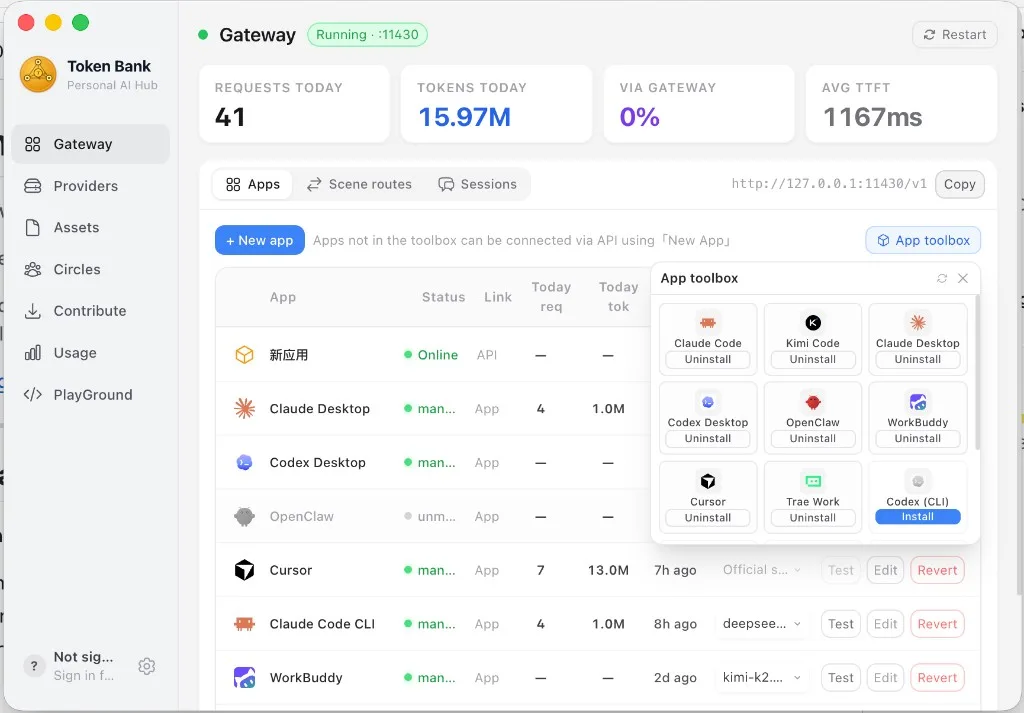
In the Gateway tab, installed tools appear automatically. Three clean states: track only · via gateway · reverted.
Swap to any third-party model in a click — no client changes.
http://localhost:11430/v1
One local routing chain, stepping down until it hits.
Each app can bind its own scenario route; the global supply chain is the fallback. When local is unavailable it switches to community sharing — transparent to the agent throughout.
A multi-dimensional dashboard,
aggregated across devices.
Desktop, CLI, and server gateways each register as a device; after sign-in, usage is reported and merged in the cloud.
Personal and community compute, scheduled as one.
Use your own free tiers, subscriptions and metered accounts first; tap community shared compute when needed; hire community agents without shipping their configs — all inside one gateway.
Personal compute
Supply under your name: local Ollama, vendor free tiers, app/API subscriptions, and metered accounts billed at list price.
Community compute
Members contribute idle quota, shared through a credits network. Spend credits to call models others supply — often cheaper than official.
Hire agents
List projected assistants for others to hire, or hire community agents yourself. Jobs run on the owner’s device — configs and API keys never leave their machine.
Cross-model exchange
Contribute quota for models you have, earn credits, and spend them on models you don't.
Time-shifted value
Idle quota becomes credits you bank — draw on them anytime later, across models and hours.
Transparent mutual-aid
Open rules, open source. The contribution rate beats the consumption rate; higher quality earns a higher multiplier.
Contribute idle quota,
get spendable credits.
Contribute local Ollama, idle upstream quota, even private models on a corporate intranet — agents dial out over WebSocket, no inbound ports needed.
Steadier uptime, faster responses, and higher success rates raise your quality multiplier — long-term contributors come out ahead.
Find your people,
share models and credits.
Create or join circles of like-minded AI users. Share contributed models inside the group, invite friends for mutual credit rewards, and contribute to multiple circles at once.
Spend your tokens where they count.
One local address fronts every AI tool and agent workflow. Double-click to install on macOS / Windows, or run from the CLI on Linux.
Common questions.
How is Token Bank different from calling the API directly? +
Your tools keep their native model names and configs — Token Bank sits in between as one local address. It traces every token, routes to the cheapest viable source, compresses requests losslessly, and converts protocols, all transparently.
Are my API keys uploaded to the cloud? +
No. Keys stay on your machine and are used only by the local gateway. Sign-in syncs usage statistics for cross-device aggregation — never your credentials.
Is community compute safe to use? +
Community routing is opt-in and only used as a fallback. Contributors dial out over WebSocket with no inbound ports exposed; settlement rules are open and credits are auditable, so contribution always out-earns consumption.
Which models and providers are supported? +
Anthropic, OpenAI, and Codex protocols are auto-converted, plus Ollama, Groq, GitHub Models, and any OpenAI-compatible endpoint. You can swap in third-party models per app without touching the client.
Is it free and open source? +
Yes — Token Bank is Apache-2.0 licensed and free to download for macOS, Windows, and Linux / Docker. Community credits are earned by contributing, not bought.
What are Circles? +
Circles are small communities inside Token Bank. Create or join via invite link, share models scoped to your circle, post messages to coordinate, and earn mutual credit rewards when friends join. You can contribute to multiple circles at once from the Contribute settings.
What is agent orchestration in v0.5? +
In Playground, pick a main agent as the aggregation entry. It receives your task, can plan steps, and dispatch work to other onboarded agents (including hired community agents). Combined with multi-account CLI and the MCP / Skill / Prompt resource hub, Token Bank becomes a local agent control plane, not only a token proxy.
What is hiring agents? +
On Contribute, list projected assistants for others to hire: only the card and bio are public; configs and API keys stay on your machine, and jobs run there. You can also hire online community agents—tasks execute on their device without downloading their source; shareable links let others try them out.